How to Price Fixed-Price Software Projects Without Losing Money
A structured pricing framework for software freelancers who want predictable margins on fixed-price contracts.Includes formula, real example, and a one-page quoting system.
Why fixed-price projects get underpriced
Most Fixed-Price Quotes Are Wrong
Most software freelancers calculate fixed-price projects like this:Estimated hours × hourly rateExample:
70 hours × $80 = $5,600That number feels logical.
It is also incomplete.Because fixed-price contracts are not about time.They are about risk.
Where Freelancers Actually Lose Money
When you price fixed-price projects like hourly work, you ignore:• Client communication overhead
• Internal project management time
• Scope drift
• Technical uncertainty
• Negotiation pressure
• Explicit profit structure
• In a fixed-price contract, the freelancer carries the risk.If the project expands, you absorb the cost.If it takes longer, you absorb the cost.If you misjudge complexity, you absorb the cost.Without structure, fixed-price becomes unpaid overtime.
The structured pricing model
The 5-Layer Fixed-Price Pricing Model
A profitable fixed-price quote requires layered calculation.Not a single multiplication.You need:1. Base Development Cost
2. Meetings & Admin Overhead
3. Risk Buffer
4. Negotiation Buffer
5. Target Profit MarginEach layer protects you from a different type of loss.Let’s break it down step by step.
Step-by-Step Fixed-Price Calculation
Estimate by Project Phase
Never estimate globally.Break work into phases:• Discovery / Planning
• Implementation
• QA / Bugfixing
• Deployment / Handover
• Project Management
• Client Communication
• Unknowns / BufferExample:Discovery: 6h
Implementation: 40h
QA: 8h
Deployment: 4h
Project Management: 4h
Client Communication: 3h
Unknowns: 6hTotal: 71 hours
Step 1 — Base Development Cost
Considering a $80 hourly rate.71 × 80 = $5,680This is your time cost before buffers and profit.
Step 2 — Apply Meetings & Admin Overhead
Meetings, coordination, and planning add overhead.Meetings/admin overhead: 10%This percentage is applied to the base cost.$5,680 × 10% = $568
Step 3 — Apply Risk Buffer
Risk buffer protects against:• Scope uncertainty
• Technical surprises
• Underestimated complexityRisk buffer: 15%Applied to base cost:$5,680 × 15% = $852
Step 4 — Apply Negotiation Buffer
Most fixed-price contracts involve price discussion.Negotiation buffer: 5%Applied to base cost:$5,680 × 5% = $284
Step 5 — Apply Target Profit Margin
Profit margin ensures the project is financially sustainable.Target profit margin: 20%Profit is calculated on the subtotal:$7,384 × 20% = $1,476.80
Final Structured Quote
Subtotal: $7,384
Profit: $1,476.80Final project price:$8,860.80This is the number you quote.
Without structure you would have quoted
$5,680Difference: $3,373That difference is not “extra money”.It is risk protection, negotiation room, and structured profit.
Fixed Price vs Hourly
Fixed Price vs Hourly for Software Freelancers
Hourly billing:• Client carries time risk
• Income capped by hours
• Limited upsideFixed-price billing:• Freelancer carries risk
• Higher effective hourly potential
• Requires structured pricingFixed-price becomes dangerous only when priced like hourly work.Structured fixed-price pricing increases:• Margin predictability
• Negotiation confidence
• Effective hourly incomeThe difference is structure.
Meetings & Admin Overhead
Most freelancers only estimate development time.But fixed-price projects always include non-development work:• Client calls
• Clarifications
• Scope alignment
• Internal planning
• Status updatesEven if this time feels small, it accumulates.In structured pricing, you account for this explicitly using a percentage.Example:Meetings/admin overhead: 10%This percentage is applied to the base cost.It ensures that coordination time is not unpaid work.Ignoring this layer is one of the simplest ways to underprice a project.
Risk Buffer (Protection Against Uncertainty)
Risk buffer is not pessimism.It is professional realism.Fixed-price projects contain uncertainty:• Requirements may evolve
• Technical challenges may appear
• Third-party integrations may fail
• Clients may change prioritiesEven when scope seems clear, uncertainty exists.The risk buffer accounts for that uncertainty.Example:Risk buffer: 15%This percentage is applied to the base cost.General guideline:• Very clear scope → 10–15%
• Moderate uncertainty → 15–20%
• High complexity or unclear requirements → 20–30%Most freelancers underestimate risk.They price the ideal scenario.The risk buffer protects you when reality differs from the ideal.Without it, you absorb the difference.
Negotiation Buffer (Tactical Flexibility)
Fixed-price contracts often involve negotiation.Clients ask:“Can you do better on price?”
“Can we round this down?”
“Can you adjust this slightly?”If your quote already contains no room for movement, you are forced to:• Reduce profit
• Remove scope
• Or accept lower marginsA negotiation buffer solves this structurally.Example:Sales/negotiation buffer: 5%This percentage is applied to the base cost.It gives you flexibility without destroying your profit margin.It allows you to:• Offer small concessions
• Close deals confidently
• Maintain structured pricingNegotiation should be planned — not emotional.
Target Profit Margin (Business Sustainability)
Profit is not the same as risk.Risk buffer protects against uncertainty.Profit margin defines your business outcome.Many freelancers confuse income with profit.If you only calculate time cost plus buffers, you are covering uncertainty — but not building margin.Your target profit margin ensures that:• Your business is sustainable
• You invest in growth
• You compensate for opportunity cost
• You earn above pure time costExample:Target profit margin: 20%In DevCalc, profit is applied to the subtotal after buffers.This ensures your final quote reflects both protection and profitability.Without an explicit profit margin, you are working safely — but not strategically.
The One-Page Fixed-Price System
Apply This Model Without Rebuilding Spreadsheets Every Time
Understanding the structure is one thing.Applying it consistently on every project is another.Most freelancers know they should include:• Overhead
• Risk buffer
• Profit margin
• Negotiation spaceBut in practice, they:• Forget one layer
• Change percentages emotionally
• Recalculate everything manually
• Lower the price under pressureStructure only works if it is repeatable.
Fill One Page. Everything Calculates Automatically
DevCalc implements the exact structured model described above.You fill only the Input tab:• Hourly rate
• Target profit margin (%)
• Risk buffer (%)
• Meetings/admin overhead (%)
• Sales/negotiation buffer (%)
• Project phases and estimated hoursThat’s it.All calculations update automatically.No manual formulas.
No hidden logic.
No rebuilding spreadsheets.
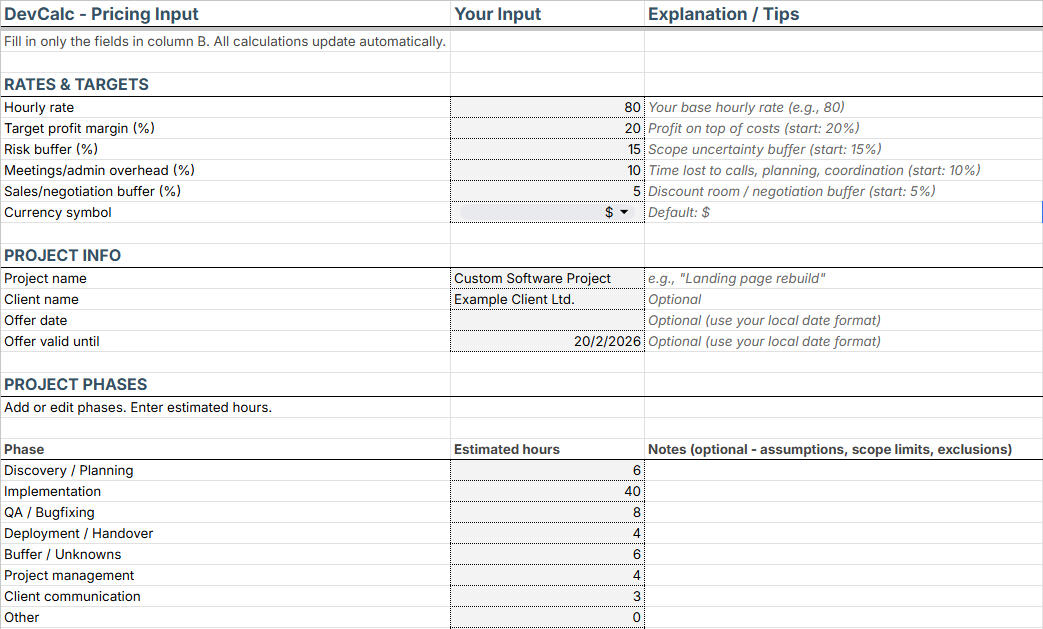
Fill only column B in the Input tab. Everything else updates automatically.
Automatic Calculation of Buffers and Profit
DevCalc calculates:• Base cost
• Meetings/admin overhead
• Risk buffer
• Negotiation buffer
• Subtotal
• Profit
• Final project priceUsing the exact structured logic explained in this guide.
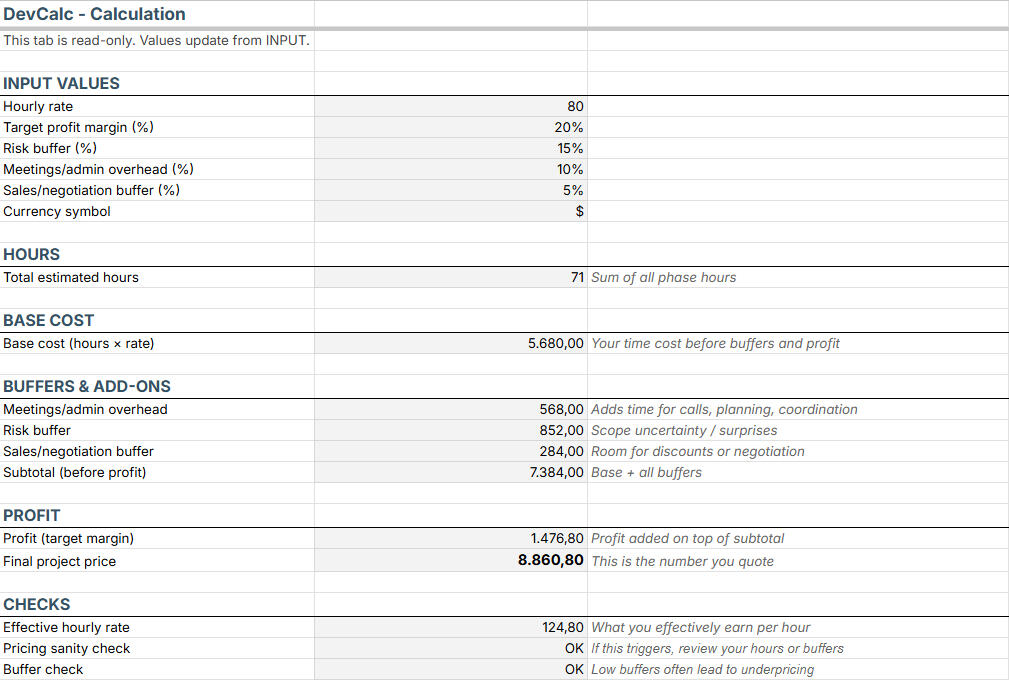
Buffers and profit are calculated automatically based on your input values.
Generate a Client-Ready Proposal Instantly
After entering your numbers, DevCalc generates:• Project name
• Client name
• Phase breakdown
• Final fixed price
• Offer validity
• Structured presentationYou can export it as a PDF and send it directly to your client.
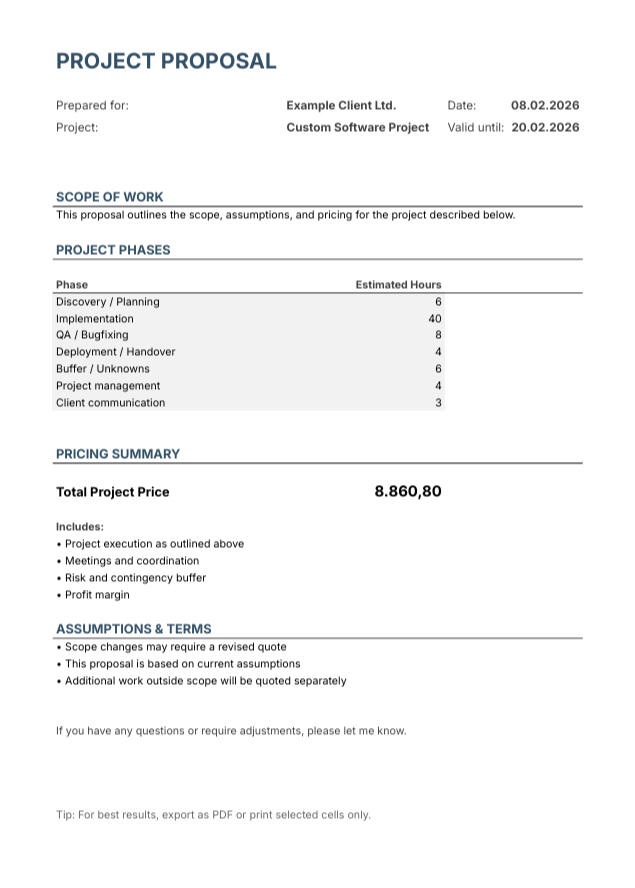
Create a structured, client-ready fixed-price proposal in seconds.
Stop Guessing Your Fixed-Price Quotes.
DevCalc gives you a structured, repeatable pricing system you can use on every project.
Structured fixed-price calculation model
Automatic risk, overhead & profit calculation
Client-ready proposal generator
Editable project phases
PDF export ready
Simple step-by-step instructions
One-time purchase. Instant download. No subscription.